Showing posts with label St. George Island. Show all posts

20 September 2010

St George Island Airport

What was my "job" on St. George? Among the millions of birds that breed and nest on St. George are hundreds of thousands of Kittiwakes - both Black-legged and Red-legged. Given certain weather conditions, especially on windy days, many of these kittiwakes like to loaf on the airport runway. Of course, this presents a significant hazard for passenger and freight planes during landing and take-off. My job was to keep these birds off of the runway when flights were due to land.

The airport was moved from the north side of the island near the town to the south side near the harbor about 1992. Originally, the runway was gravel, but it was paved about 4 years ago. The first terminal building was "affectionately" referred to as "Apollo" because of its resemblance to the moon landing vehicle. The present terminal facility, while not very fancy, is adequate and much better than the original. There are three scheduled passenger flights to St. George per week and an occasional unscheduled flight or charter passenger flight. Saab 340 aircraft are used for passenger flights. Freight/cargo flights are unscheduled and erratic in nature, requiring continual monitoring to determine when they may be arriving. The arrival of cargo flights is announced to the residents by phone and over VHF radio and usually results in a rather disorganized scramble because folks are anxious to get items they may have been ordered a month or more previously. When planes were scheduled to arrive, I usually headed to the airport about an hour or so beforehand. If kittiwakes were on the runway, I would harass them with my pickup and then turn on at least half of the eight propane canons that were set to fire perhaps once a minute or so. Groups of loafing kittiwakes often numbered in the thousands. But the canons were quite effective in keeping them from sitting on the runway, so other scare tactics, such as shotgun propelled firecrackers were seldom needed to keep the runway clear.The only real problems with the propane canons was to keep them operational during long periods of fog and mist. A reliable supply of propane is a potential future concern since the cost is quite high. Presently, it costs $60 to fill each 25 gallon cylinder. In 2011, propane may not be available from sources on the island so supplies will have to be shipped specially to St. George for the propane canons, a potentially expensive option. This "job" of mine seemed to be fairly simple and for the most part it was. But fog and mist frequently interfered with landing schedules so flight delays were common, and indeed, frequently the rule. Some days, there was a wait of 3-4 hours or so before a decision was made regarding the cancellation of a flight from the mainland. Patience was a requisite aspect of the job!!

03 September 2010

Here Come The Clowns!

The Auklets - Least, Parakeet, and Crested - are one of the other groups of seabirds that nest on St. George Island in large numbers. However, in my opinion, they are not all that attractive, lacking much variety in plumage colors and with no distinctive pattern. Despite the lack of these attributes, these birds were really quite photogenic. I suppose that was because they were quite tame and they were vocal and animated. While I did not take as many photos of them as I did of puffins, I did fill up my cameras memory card with their images on many occasions. Below, all three species posed for me. From left to right - Parakeet, Least and Crested.Crested Auklets were not at all abundant on St. George, but I was fortunate to find them in a number of locations where they cooperated for some good photos. Other breeding areas to the north apparently have much greater numbers of this species and I just read a note where some birders on St. Lawrence Island estimated about a million of them passing a point near the town of Gambell on that island. It is easy to figure out how they got their name.Least Auklets were the smallest but by far most abundant of the group. Most apparently nested inland in the rock-fields below ridge lines where there were many burrows where they could remain relatively secure from predators, mostly Arctic Foxes.


Of the three species, I would probably rate the Parakeet Auklets as the most attractive, but that isn't saying much. They seemed to be quite a bit more abundant on the cliffs later in the season than the other species.

31 August 2010

Puffin Mania on St. George!

I fell in love during my visit on St. George Island - with Puffins!! It was love at first sight! Compared with other birds, especially those colorful ones from the tropics, puffins are really not all that beautiful. It must be their overly large orange or orange/yellow bills that attracts me. These birds have intrigued me ever since I saw my first pictures of them. But the St. George birds were the first live ones I ever saw in their breeding plumage, with the large, colorful base to their bills and their orange legs and feet. In between, they are mostly just black and white. Their common names - Horned Puffins and Tufted Puffins - are not especially noteworthy for such distinctive species, although I certainly do like the "Puffin" part. Of the two species, the Horned Puffin was my favorite to photograph.

In my first few days on the island, I was fortunate enough to get quite a few good images of these favorites, and quite near the town site. Their abundance in no way matched that of the other birds that used the cliffs for breeding/nesting sites. Most often, I had to look carefully to find them among the myriads of kittiwakes and murres that adorned the cliffs. But you would never know that fact based on a perusal of all of my photos. The hundreds - or maybe a thousand - pictures I took of Puffins were far in excess of their real abundance. Several times, after reviewing the library of photo images I had accumulated on my computer, I said to myself "No more pictures of puffins, I have more than I need already". Then the next time I walked along the cliffs and viewed a few of these unique seabirds, I would think to myself, "Why not take a few more pictures? I can always eliminate the ones that are not satisfactory." This sequence of thoughts and events happened again, and again, and again.......

Now it is time to select some of my favorite Puffin images - and that is a really difficult chore for me. If you don't agree with my selections, you can always go to my Flickr site for more options!

It is not difficult to differentiate these two species. Tufted Puffins have a row of creamy white feathers extending back over their eye and white face, with a body that is all black. Horned Puffins have a small horn-like projection above each eye, with white undersides and black feathers above. Both species were quite easy to approach when perched near the top of cliffs, and some of my pictures I took from perhaps 25-30 feet away. These birds even induced me to overcome my acrophobia and lean over cliffs to get better shots of them. In one location, I had my friend Vern hold on to my legs so that I could get in a better photo shooting position. The only disappointment I had with these birds is that I never saw any young ones. The adults nest in crevices and holes in the cliff faces and no young ventured out in the open while I was looking.

Enough with all of the chatter! Below are about a dozen of my favorites - with no interruptions from me!! Remember, you can enlarge an image by clicking on it.


29 August 2010

St. George Scenery

A carpet of blues and intense greens greeted me on my initial drive from the Airport on the south side of St. George to the town where I would spend much of the next 37 days. The blues were mostly the result of a species of Lupine that I have seen referred to variously as Nootka or Arctic Lupine. Interspersed within these large patches of blue were yellow Arctic Poppies, and a number of other flower species in full bloom. The main east/west ridge line bisecting the island had a few snow banks remaining that made for a nice contrast. The greens, reminiscent of Ireland, were composed of several species of wide-bladed grasses and other variable shades of green consisting mostly of moss and lichen covered rock fields, with a variety of sedges.
St. George seems to be primarily of volcanic origin. It is different from its sister island St. Paul in that it is more topographically diverse and has few beaches that are accessible for walking. Zapadni Beach just to the west of the harbor complex on the south side of the island is about the only easily accessible beach for walking. Zapadni was is a black sand beach with some designs made by wave action on broken sea shell fragments, and kelp washed up during high tides. The few other beach areas such as Garden Cove are reached only after a considerable hike. Most of the other shoreline areas consist of cliffs ranging up to over 1,000 feet at High Bluff. A very rough guess on my part would estimate a shoreline of perhaps 40 or more miles with no more than about 5% being walkable, sandy beach. But the many miles of cliffs (Vern Schneider photo)are the primary reason that the island supports the estimated 2.5 million nesting seabirds.

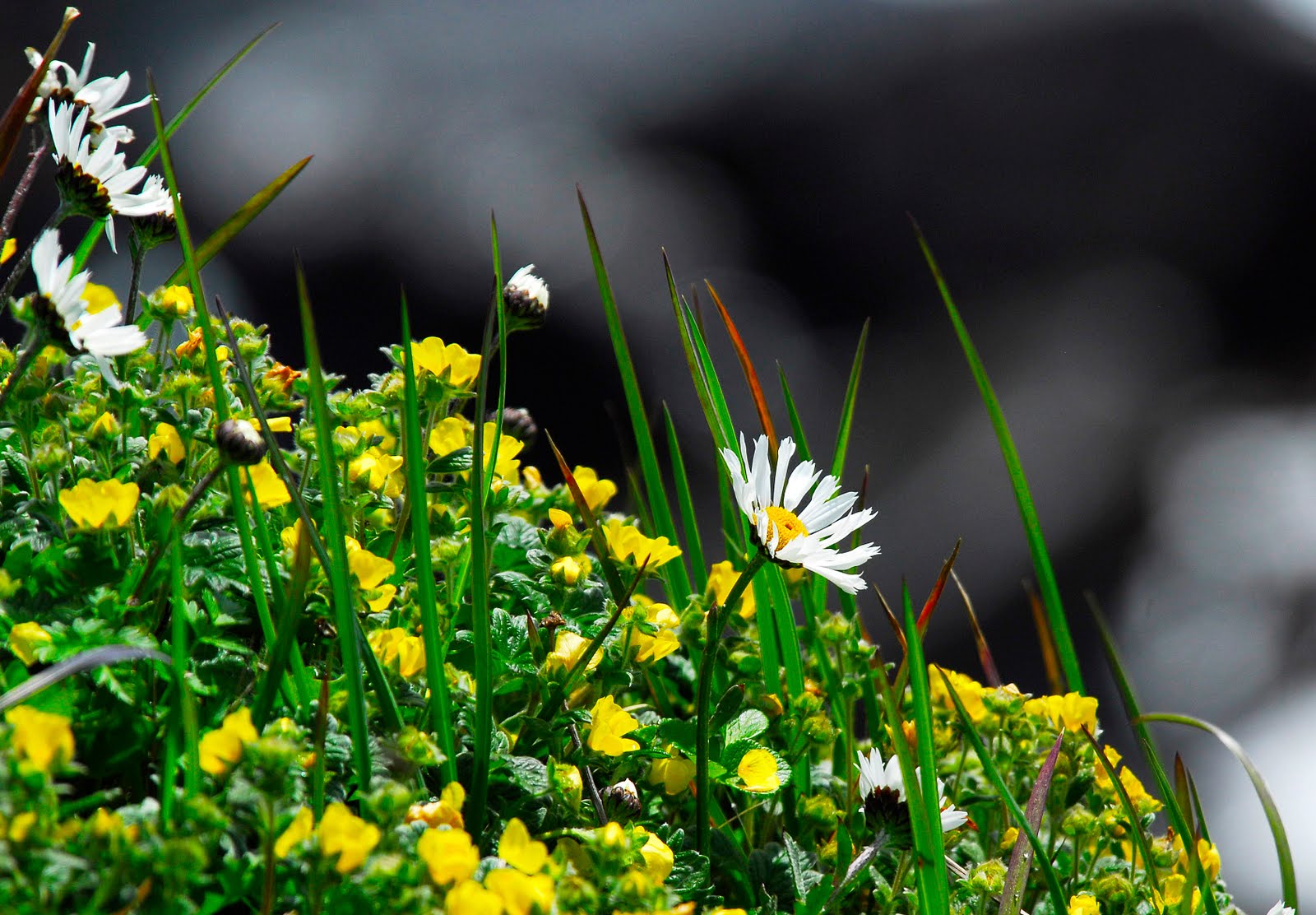
While we didn't have a lot of sunny days to highlight the vibrant colors of the island, we took advantage of the sun when it appeared to take lots of pictures. A hike to First Bluff several miles west of town provided some good opportunities for flower pictures. Here, great friend Vern Schneider who stayed with me for 3 weeks, focuses in on a few of the plethora of flowers we found there. But foggy and cloudy days also provided some great opportunities for capturing scenes with a very serene aspect. As the summer progressed, other flower species began their blooming process and made for colorful panoramas.The Bering Sea is famous for savage winter storms. We did see some wind and high swells while we were there. But they were nothing like what winter sometimes brings to the Bering Sea. February 2008 brought winds of 120 knots that blew the roofs off some houses in town. The image below is about as close as I got to experiencing a sunset on St. George.