For many years, a trip to the Galapagos Islands has been on my "bucket list". The celebration of my wife Kathy's retirement was just the excuse I needed to plan such an adventure. To make such a trip more interesting for her, we added a bonus extension to Peru and the the ancient Inca Empire city of Machu Picchu. In this travel and natural history blog series, I will first present my thoughts and images of the Galapagos.
Straddling the equator nearly 4000 miles SE of our home in Helena, MT,

the Galapagos Archipelago lays about 600+ miles off the west coast of Ecuador.

It consists of about 19 islands and many smaller "islets" and rock outcrops of volcanic origin. The two most western islands of the group - Isabela and Fernandina - are among the most active volcanic areas on earth. None of the islands is more than 5 million years old and Fernandina is thought to be only about 100,000 years old. The latter is the largest pristine island in the world, with no human habitation or introduced plant or animal species.

Europeans first discovered the islands in 1535 when the Spaniard Fray Tomas de Berlanga and his ship were carried there by ocean currents. His accounts of the islands described the giant tortoises and iguanas and he commented on the tameness of the birds. Pirates were the first to use the islands and were later followed by whalers in the 1790's through the 1800's. In addition to decimating the whale populations, fur seals were hunted almost to extinction and many thousands of tortoises were removed for food. In 1832, the Galapagos were officially annexed by Ecuador , but Settlement did not occur until the late 1800's and into the early 1900's.
As you well know, the most famous visitor to the Galapagos was Charles Darwin, aboard the HMS Beagle in 1835. Although he only spent a total of about 20 days on the islands, observations he made there and elsewhere on his 5-year voyage provided the basis for his classic
The Origin of Species published 24 years later. This publication, of course, lead to profound changes in how man perceived processes in nature and evolution. In 1959, the Ecuadorian government declared the Galapagos National Park to protect all parts of the archipelago that were not already occupied or farmed by people.
Our trip to the the Galapagos began with a flight to Baltra Island and then embarkation on the ship
National Geographic Islander. This is a 48 passenger ship operated by Lindblad Expeditions and National Geographic.

It proved to be an excellent craft for island hopping and was manned by a great crew and naturalists who were exceptionally well versed in the natural history of the islands. Their knowledge of and love for the islands, and concern for island preservation, was obvious from the "get go" and an inspiration to me and the other passengers.
We spent 8 days and 7 nights on the
Islander, visiting 8 different islands. Most of the distance travel between islands was done at night, with short trips between landing sites sometimes done during lunch time. Island landings were accomplished using the Zodiacs. These inflatable craft were very versatile and the crew had them in the water usually within five minutes or so after we anchored.
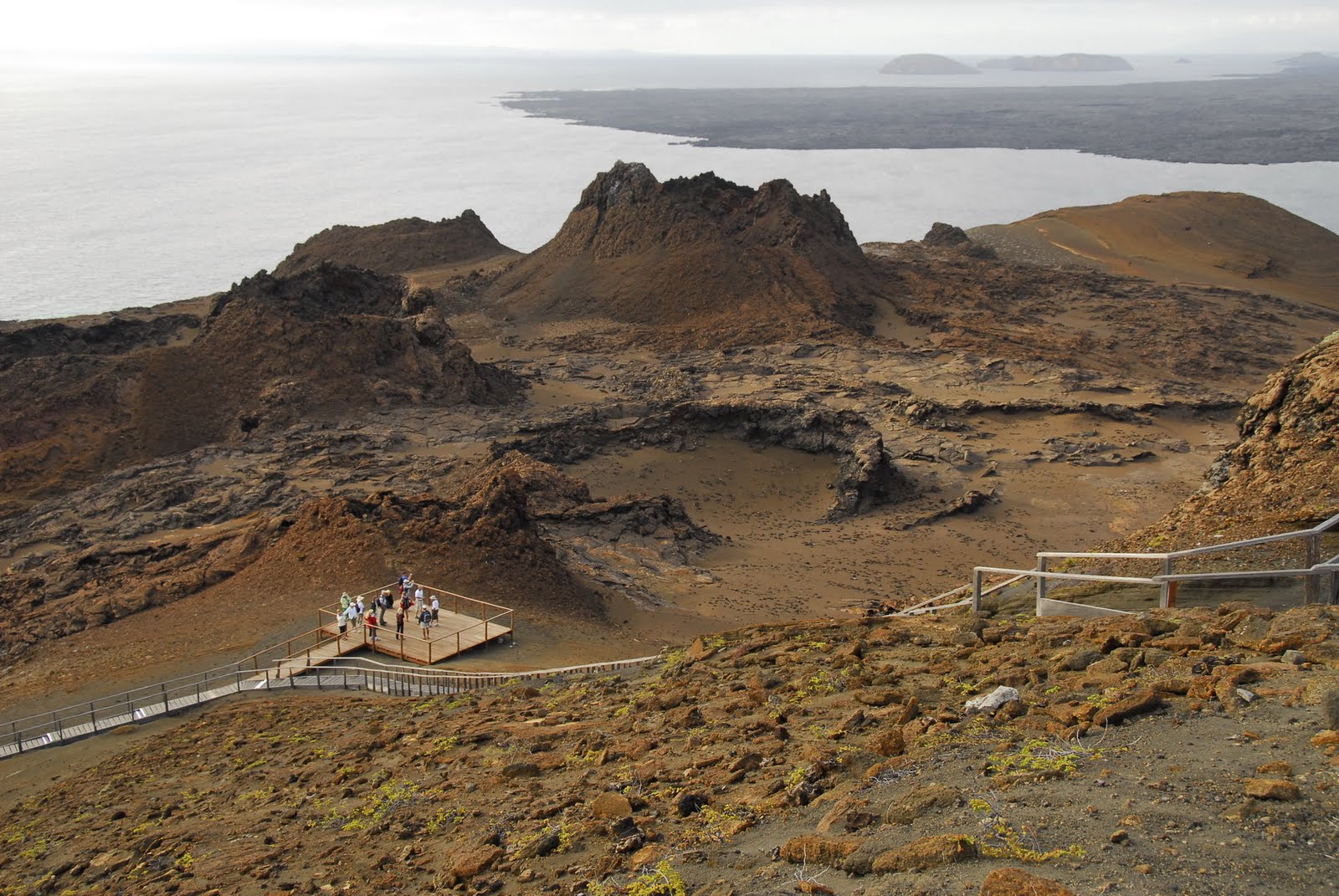
The scenery in the Galapagos was not what I would classify as beautiful or idyllic, but it certainly was interesting.


But for me, the mystique of the islands lay in the uniqueness and tameness of the fauna and the distinctiveness of the flora.
In the Galapagos blogs to follow this one, I'll discuss and provide images of the people, vegetation, birds, mammals, and reptiles inhabiting these very interesting and relatively isolated islands - that continue to give us a plethora of scientific knowledge important for the understanding of evolution.
 but in my rush to get out of the house I forgot boots, so my usual pursuit of birds would have to suffice. To my surprise, there were birds about and they provided some rewarding opportunities for photos. The following images were ones I acquired that beautiful morning. My first encounter was with a prairie falcon that sat calmly on a power pole for a relatively close approach, an unusual case for this species.
 Next up, a dark phase rough-legged hawk flushed out of a cottonwood tree upon my approach, but didn't get far before my camera caught up with it.
  There is one side road where I frequently find a bald eagle perched this time of year, so I tured there to take a quick look. I was rewarded with an adult eagle sitting on the same old snag where I usually find one,
  and as a bonus, a female rough-legged hawk was perched nearby.
  At this point in the morning, the fog began to lift and the bright sun highlighted the frost encrusted vegetation so that it looked like fine embroidered lace. As I passed by a weedy field, I caught a glimpse of some small birds flitting among the stems looking for seeds to eat. They were American tree sparrows, a fixture in our valley in the winter, arriving early from their breeding areas far to the north. They are usually in small bunches, but as I stopped my vehicle, more and more of them appeared. There were dozens of them. Something made them nervous, perhaps me watching them, and suddenly they all flushed to a nearby caragana hedge. I backed up, stopped near the hedge, and did some "pishing" to try to coax them into the open. Slowly, several of them began to hop up to the higher branches of the shrubbery. During the next hour, I clicked the shutter of my camera perhaps a hundred times trying to get that perfect shot of one of these neat little sparrows - perched on a lace covered stem silhouetted against the clear blue sky.

 That one great morning in the Helena Valley has quieted my need in the past week to venture out for some winter birding again. But I can feel that urge growing in me, so hopefully our new snow of today and falling temperatures will again combine to provide another of those memorable days. Sitting and looking at this computer all day just doesn't do it for me!